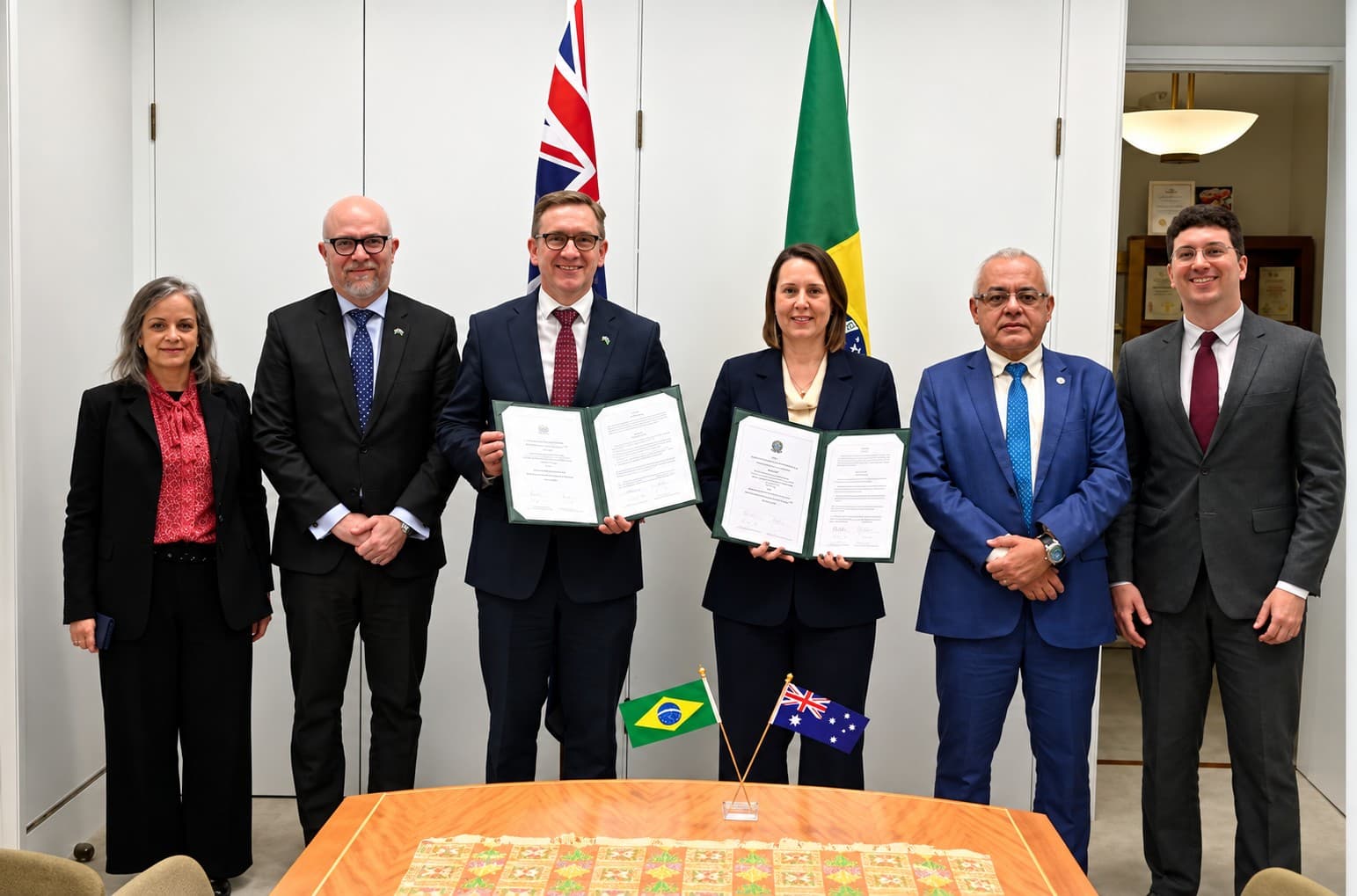
Australia and Brazil Renew Education and Research Agreement, Deepening Bilateral Cooperation
Australia and Brazil have renewed a major Memorandum of Understanding on Education and Research, strengthening cooperation between the two countries in higher education, academic exchange and research.
The new agreement was signed on 13 August 2026 by Australia’s Assistant Minister for International Education, Julian Hill MP, and Marta Wendel Abramo, Secretary of Regulation and Supervision of Higher Education at Brazil’s Ministry of Education. The Australian Department of Education formally announced the agreement on 18 August.
The Memorandum of Understanding, or MoU, reaffirms a long-standing education relationship between Australia and Brazil and provides a framework for the two governments to continue developing cooperation between universities, research institutions and education authorities.
A relationship that goes back decades
The 2026 agreement is not the first education arrangement between the two countries.
Australia and Brazil have been developing formal education cooperation for years. A previous Memorandum of Understanding covering education, research and vocational education and training was signed in 2015, while the wider Australia–Brazil Strategic Partnership dates back to 2012.
According to Australia’s Department of Foreign Affairs and Trade, the two countries now cooperate across a wide range of areas including education, scientific research, trade, investment, the environment and human rights. Australia and Brazil first established diplomatic relations in 1945.
The new 2026 Education and Research MoU now sits alongside several other agreements, including a 2020 research cooperation agreement, a 2017 Science, Technology and Innovation Agreement, and cooperation between Australia’s CSIRO and Brazil’s Embrapa in agricultural science.
Brazil is already a major source of international students in Australia
The agreement comes at a time when the connection between Brazilians and Australia’s education system is already significant.
Official Australian Government figures show that 23,937 Brazilian students were studying in Australia in 2024. Brazil is also home to one of the strongest people-to-people links between Australia and Latin America.
The Australian Government says Brazilians are now the largest Latin American migrant group living in Australia, further increasing the importance of educational, professional and research links between the two countries.
For Brazilian students, Australia has long been an attractive destination for English-language study, vocational education, university degrees and postgraduate research.
But this renewed agreement goes beyond simply attracting international students.
Its broader significance is the possibility of building stronger institutional relationships between Australian and Brazilian universities and research organisations.
What could the agreement mean in practice?
A Memorandum of Understanding is generally a framework for cooperation rather than a promise of automatic scholarships or new visas.
The 2026 agreement creates a formal government-to-government structure through which Australia and Brazil can continue developing education and research initiatives.
That can potentially support areas such as university partnerships, academic collaboration, joint research, knowledge exchange and institutional cooperation.
It is important, however, to distinguish the agreement from a new student visa program or scholarship announcement. The Australian Government has not announced that the MoU itself creates automatic scholarships, permanent residency pathways or additional student visa places for Brazilians.
Its main importance is institutional: it provides a framework for the two countries to work more closely on education and research.
Research cooperation is becoming increasingly important
Research is a particularly significant part of the Australia–Brazil relationship.
Australia already lists Brazil as a priority partner for international education engagement and maintains specific resources covering Brazil’s research ecosystem and bilateral cooperation agreements.
The relationship is also producing practical projects.
One example is a partnership led by Queensland University of Technology and Fundação Getulio Vargas to establish an Australia–Brazil Research and Practice Forum focused on responsible critical-minerals supply chains.
The project includes activities in São Paulo and Brisbane and is intended to bring together researchers and specialists through presentations, masterclasses and roundtable discussions.
This demonstrates how bilateral cooperation can move from government agreements into university and industry-level research.
Why Australia and Brazil have common research interests
Despite being geographically distant, Brazil and Australia share several characteristics that make research collaboration particularly relevant.
Both are large resource-producing economies with major agricultural sectors, extensive mining industries, significant biodiversity and strong interests in renewable energy, environmental management and climate research.
Previous bilateral agreements have already identified areas such as agriculture, mining, energy, biotechnology, nanotechnology and space science as potential fields for joint research and development.
More recently, critical minerals have become another area of cooperation, including research involving Queensland institutions.
What does it mean for Brazilians already in Australia?
For the Brazilian community, the agreement may not produce immediate changes to visas or tuition fees, but it strengthens the institutional relationship behind education and research between the two countries.
It could eventually contribute to more partnerships between universities, academic mobility, collaborative research projects and closer contact between Brazilian and Australian educational institutions.
The scale of the relationship is already considerable.
Apart from the almost 24,000 Brazilian students recorded in Australia in 2024, the 2021 Australian Census counted 46,720 Australian residents who were born in Brazil.
These connections mean education cooperation is increasingly linked not only to international students, but also to Australia’s growing Brazilian community.
Australia is also changing its international education system
The agreement comes during a period of significant reform in Australia’s international education sector.
The Australian Government has set a National Planning Level of 295,000 new international student commencements for 2026, with the same level to remain in place in 2027. The government says the objective is to manage international education growth more sustainably.
Australia has also introduced additional measures aimed at improving the integrity of the international education sector, particularly in vocational education.
This means stronger Australia–Brazil cooperation is developing at the same time Australia is becoming more selective about how its international education system grows.
More than an education agreement
The renewed MoU forms part of a much broader relationship between the two countries.
Australia and Brazil cooperate through international organisations including the United Nations, G20 and World Trade Organization, and have agreements covering science, research, agriculture, visas, water cooperation and law enforcement.
For both countries, education and research are increasingly becoming another bridge connecting governments, universities, researchers and communities.
The 2026 agreement therefore represents more than another diplomatic document.
It provides a renewed foundation for Australia and Brazil to deepen a relationship that is already being built through thousands of students, researchers, universities and members of the Brazilian community living in Australia.
Source and Credits: Australian Government Department of Education; Australian Government Department of Foreign Affairs and Trade; Australian Embassy in Brazil.
Research and adaptation: Portal Gringo News.
I would use the website headline:
Australia and Brazil Renew Education and Research Agreement, Strengthening Opportunities for Students and Universities
And for the homepage preview:
Australia and Brazil have renewed a major education and research agreement, strengthening cooperation between universities, researchers and government institutions as nearly 24,000 Brazilian students already study in Australia.


Comments
Loading the conversation…
Comments are moderated after they go up. Anything abusive, defamatory or off-topic gets removed — see the comment policy.